Antidepressant Withdrawal and Relationships: When Connection Changes
Antidepressant Withdrawal and Relationships: When Connection Changes
Antidepressant withdrawal happens to one person, but it does not happen in isolation. It happens in the middle of a life that already contains other people: partners, parents, children, brothers and sisters, friends, colleagues and the wider circles of people with whom our lives overlap.
This matters because many of the changes that can happen during withdrawal are experienced not only by the person going through them, but by the people around them. If conversation becomes difficult, there is somebody who can no longer have the conversations they once had. If a person needs more time alone, there may be somebody wondering why they no longer want their company. If affection disappears, somebody may miss being held. If messages become impossible to answer, there are friends at the other end of those messages who may eventually stop sending them.
From inside withdrawal, these things may be part of trying to get through the day. From outside, they can look and feel very different.
This is where relationships can become particularly vulnerable, because we do not simply experience what another person does. We try to understand what it means. Someone stops calling and we wonder whether they still care. A partner becomes distant and we wonder whether something has changed between us. An adult child who once managed their own life begins needing help and a parent wonders how much to step in. A parent becomes irritable or unavailable and their children may have no idea why.
The behaviour is real and its impact on other people is real, but the meaning we give it may be much less certain.
Withdrawal happens in the middle of a human life
Much of what is written about antidepressant withdrawal understandably focuses on the person experiencing it. Symptoms can be severe and bewildering, and the need for recognition and understanding is enormous.
But a human life is relational.
We are somebody's partner, child, parent, sibling or friend. We work with people, live alongside them, make plans with them, rely on them and are relied upon by them. We have histories together and established ways of knowing one another. Much of the security in our relationships comes from familiarity. We know how somebody normally responds, what silence means, how they show affection, when they need space and when something is wrong.
Withdrawal can disturb that familiarity.
A person may still look exactly the same while responding in ways that are unfamiliar to everybody around them. They may also be frightened by their own reactions. Things and people that once felt easy may become overwhelming. Feelings that once seemed dependable may become inaccessible. They may want to be left alone without really understanding why, or find themselves irritated by somebody they love and then be distressed by their own irritation.
The people around them are trying to make sense of these changes too, but they are doing so from the outside. They cannot feel emotional numbness, cognitive overload or the internal pressure of a nervous system that may be struggling. They can only see that somebody they know has stopped behaving towards them in the way they once did.
That gap between the internal experience and the external experience is where so much misunderstanding can begin.
When your partner feels different
In an intimate relationship, we know each other through far more than words. We know the look across a room, the casual touch when somebody passes, the way they answer the phone, the things they tell us without thinking and the ordinary affection that is so familiar we barely notice it until it is gone.
When those things change, it can be deeply unsettling.
A partner experiencing withdrawal may become emotionally numb or unable to access feelings that were once entirely familiar. They may find physical affection difficult, lose interest in sex, need far more time alone or become unable to tolerate conversations about the relationship. They may themselves be frightened by this and have no idea what it means.
The person alongside them experiences something else. They experience the missing kiss, the turned back in bed, the conversation that no longer happens, the message that receives a one-word answer and the person they love seeming to retreat further away. It is hardly surprising that they begin to wonder whether the relationship itself has changed.
And so they ask.
Do you still love me? Are we all right? Do you still want this? What's happened to us?
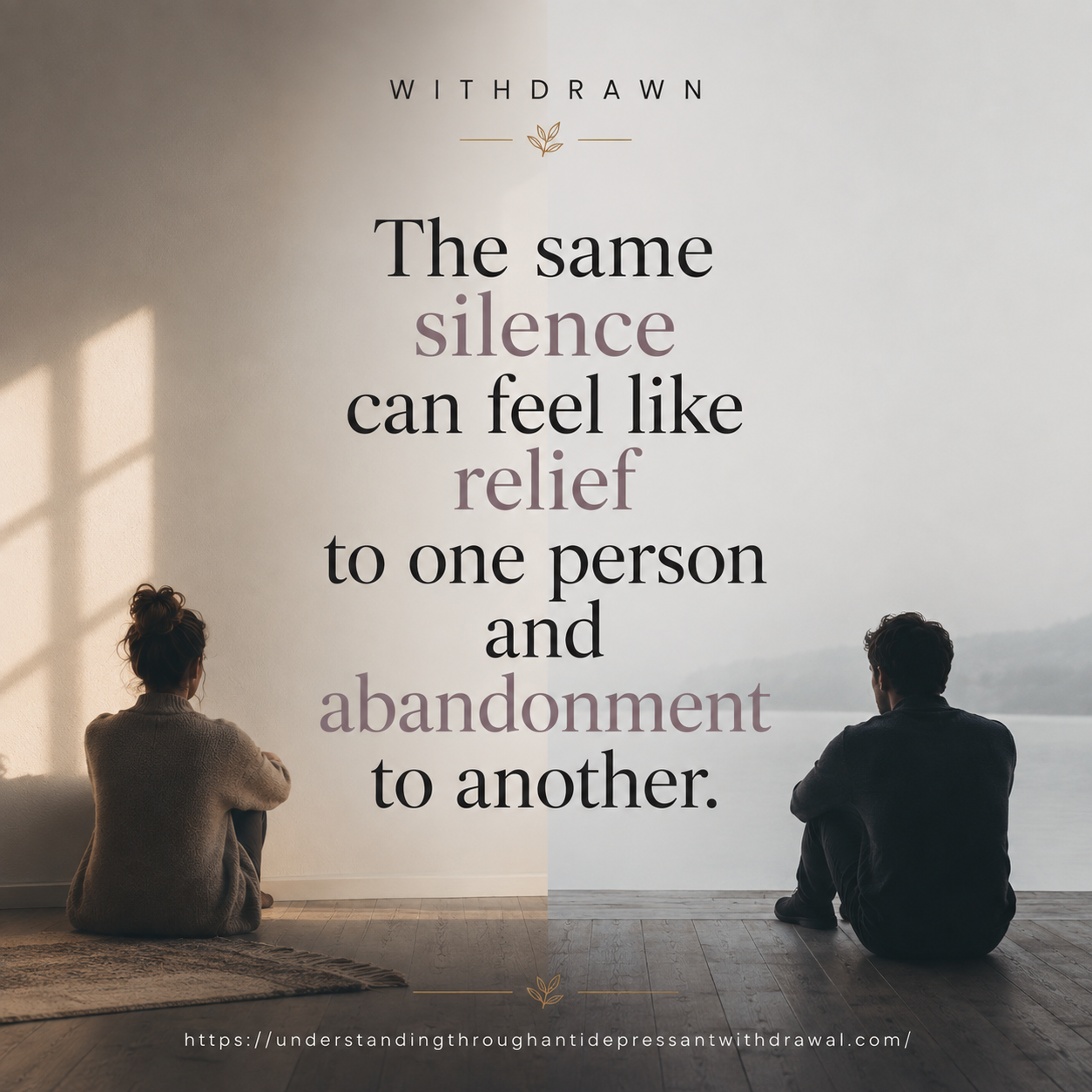
Those questions are not unreasonable. They may come from fear and from a desperate attempt to find some solid ground. But the person experiencing withdrawal may not have the answers. They may not be able to find the feelings they are being asked about, and being asked to provide certainty about them can create even more pressure.
One person then reaches harder for connection while the other retreats further from the pressure, and both can end up experiencing the other's response as evidence of precisely what they fear.
This does not mean that every relationship change during withdrawal is temporary or that withdrawal should be used to explain away everything that happens between two people. It means that there may be more happening than either person can see from where they are standing, and that making permanent conclusions in the middle of profound uncertainty can carry its own risks.
When it is your adult child
There are few things more difficult for a parent than watching their child suffer and not knowing how to help. The fact that the child is now thirty, forty or fifty does not necessarily alter the instinct to protect them.
An adult son or daughter who has always managed their own life may suddenly be frightened, confused or unable to cope with things they previously did without thinking. A parent may find themselves helping with meals, appointments, children, money or the ordinary business of getting through the week. They may spend hours reading about withdrawal because they are desperate to understand what is happening.
It can be very difficult to know where helping ends and taking over begins.
A parent who is frightened may ask repeatedly how their child is feeling, watch for changes, research possible solutions or begin making suggestions about what they should and should not do. None of this has to come from a wish to control. It may simply be what love looks like when it is frightened.
From the adult child's side, however, it may feel very different. At a time when they may already feel that they have lost some part of themselves, being watched, advised and managed can make that loss of autonomy even greater.
Other parents may respond in the opposite way. They cannot understand why their son or daughter is not simply getting on with life, particularly if they sometimes appear perfectly well. They may see somebody attend a family meal, drive a car or laugh at something and struggle to reconcile that person with the one who says they cannot manage work, socialising or ordinary responsibilities.
Withdrawal does not always present the same face to everybody.
Sometimes the most helpful thing a parent can do is ask what help is actually wanted rather than deciding what help ought to be given, while remembering that their adult child remains an adult even when they are struggling.
When the person withdrawing is your parent
The change can be equally disorientating in the other direction.
We tend to think of our parents as occupying a particular place in our lives, even long after we become adults ourselves. When a parent who has always been capable and available suddenly needs support, the change can bring worry, sadness and a strange reversal of roles.
An adult child may find themselves making phone calls, helping with practical things or becoming the person their parent depends upon emotionally. They may be deeply concerned while also feeling overwhelmed by how much has changed.
For younger children, the experience is different again. They may simply know that Mum or Dad is not quite the same. Perhaps a parent has less patience, needs more quiet, spends more time alone or no longer joins in with things in the way they once did.
Children do not need to carry adult explanations, but unexplained changes can leave space for explanations of their own. A child can very easily decide that a parent's withdrawal, sadness or irritability is somehow connected to them. Where possible, simple reassurance that Mum or Dad is having a difficult time, that the child has not caused it and that the adults are dealing with it can help protect them from carrying responsibility that was never theirs.
Brothers and sisters
Siblings can be particularly interesting because they share a history that often predates almost every other adult relationship. They may know the person extremely well, but they may also know a version of them formed through decades of family roles and expectations.
One sibling may immediately accept that withdrawal is profoundly affecting their brother or sister, while another sees the situation completely differently. One may become heavily involved and another may keep their distance. They may disagree about whether somebody needs more help or less, whether behaviour should be challenged or understood, or whether withdrawal is even the explanation for what they are seeing.
Those differences can create tensions in a family already under strain.
It is easy for one person to think, “Why can't they see what I can see?” without recognising that everybody is meeting the situation through their own relationship with the person, their own history and often a very different amount of contact.
The sister who spends three days with somebody may see something the brother who calls once a fortnight does not. The brother who receives relaxed messages may struggle to understand the description given by the partner living with that person every day. Neither necessarily has the whole picture.
When friendships begin to disappear
Friendships can be lost much more quietly.
There may be no argument and no decision to end the friendship. There may simply be unanswered messages, cancelled plans and invitations repeatedly declined until eventually the invitations stop coming.
For the person experiencing withdrawal, even answering a message may sometimes feel like another thing they cannot manage. Seeing somebody may require conversation, attention and an ability to be socially present that they simply do not have. They may think about a friend often and still not contact them.
The friend at the other end does not know this unless somebody tells them. They know that the last four messages went unanswered. They know that plans have been cancelled again. They may conclude, quite reasonably from the information available to them, that the friendship is no longer wanted.
Some friends keep trying for a while and then quietly step away, not because they never cared but because they believe they have understood the message.
This can leave somebody emerging from a difficult period to discover that parts of their social world have disappeared while they were simply trying to survive it.
Where there is enough capacity, very small amounts of communication can sometimes preserve a great deal. “I can't manage much contact at the moment, but I haven't forgotten you” may be enough. From the other side, a message that says, “No need to reply, I just wanted you to know I'm thinking of you” can maintain connection without adding another obligation.
And then there are the friends who become unexpectedly important. They are not necessarily the ones who understand withdrawal best. Sometimes they are simply the people who can tolerate not understanding everything, who continue to be there without demanding explanations, and who can still talk about a television programme, somebody's disastrous haircut or what they are having for dinner.
There can be enormous relief in being allowed to remain a whole human being rather than becoming only the person who is in withdrawal.
When the wider family has an opinion
Families are very good at producing explanations.
Somebody thinks the medication should never have been stopped. Somebody else believes medication is the problem. One person thinks therapy is needed, another thinks more exercise would help, and somebody has read something online that they are now convinced explains everything.
Meanwhile, the people closest to what is happening may be exhausted.
Withdrawal can be particularly confusing from the outside because what somebody can manage may vary enormously. A relative may see them for two hours on a reasonably good afternoon and go away thinking they seemed absolutely fine. Their partner or parent may then be left trying to explain that those two hours bear very little resemblance to the rest of the week.
This can create another kind of loneliness: not only living with something difficult, but feeling that other people do not believe what you are seeing.
It may help to remember that people are often responding to different pieces of the same reality. The fact that somebody laughed at lunch does not mean they are not struggling. The fact that they are struggling does not mean they are incapable of laughing at lunch.
Human experience is rarely as tidy as the explanations we create for it.
Work, colleagues and the rest of the world
Not all relationships affected by withdrawal are intimate ones.
A person who was previously confident at work may begin avoiding meetings or find conversation exhausting. They may struggle to concentrate, become less tolerant of pressure or simply have less capacity for the ordinary social interaction that surrounds most working lives. Colleagues who know nothing about what is happening may see somebody who has become distant, unreliable or difficult.
Outside work, social groups, hobbies and communities can begin to disappear for similar reasons. Places where somebody once experienced friendship, competence, humour and belonging can become too difficult to manage.
This matters because withdrawal can gradually shrink a person's world. If almost every conversation becomes about symptoms and almost every relationship becomes organised around how they are doing, it becomes harder to experience themselves as anything other than somebody going through withdrawal.
Ordinary connection can matter enormously, precisely because it is ordinary.
When everybody has a different explanation
Perhaps one of the hardest things for relationships is that there may be several different explanations for what is happening, and everybody may be convinced that theirs is the right one.
The person experiencing withdrawal may feel certain that withdrawal explains the changes in them. A partner may fear that something fundamental has changed in the relationship. A parent may worry that the original difficulty for which medication was prescribed has returned. A friend may think they are simply no longer wanted.
It is very human to want an explanation because explanations give us something to hold onto. The difficulty comes when possibility becomes certainty.
If everything is attributed to withdrawal, we risk dismissing real feelings, choices and relationship difficulties. The person experiencing withdrawal may begin to feel that nothing they say is taken seriously because somebody else has already decided that it is “just withdrawal.”
But if withdrawal is left out of the picture completely, behaviour and feelings arising during an extraordinary period may be interpreted as permanent truths about a person, their character or their relationships.
Sometimes we simply do not know yet.
That can be an extraordinarily uncomfortable place to stand, particularly when the question matters deeply. We want to know whether somebody still loves us, whether a friendship will return, whether our child will be all right or whether the person we knew is still there.
There are times when certainty is simply not available, however desperately we want it.
Allowing for that does not mean pretending nothing matters. It means leaving enough room for what we do not yet know.
Protecting connection when you don't have the answers
When a relationship has changed, the instinct is often to try to get it back to where it was. We talk, ask questions, seek reassurance and try to understand. Sometimes that is exactly what is needed.
At other times, particularly when somebody is overwhelmed and communication itself has become difficult, trying harder to restore connection can create more pressure and more distance.
Connection may need to look different for a while.
For a partner, that might mean being able to sit together without trying to resolve the relationship every evening. For a parent, it might mean helping with something practical without asking ten questions about how their adult child is feeling. For a friend, it may be continuing to send the occasional message without keeping score of how many have gone unanswered. For the person experiencing withdrawal, it may mean finding some small way of letting people know that silence, distance or reduced contact does not necessarily mean they no longer matter.
None of this requires the people around withdrawal to disappear into somebody else's needs. Relationships still have two sides, and understanding why somebody may be behaving differently does not remove the effect that behaviour has. The person alongside withdrawal may be lonely, frightened, angry or exhausted. They may need support and boundaries of their own. They may also reach a point where something cannot continue as it is.
Understanding withdrawal should never require us to stop seeing the people around it.
What it can do is help us become a little less certain about what everything means.
The partner who cannot offer reassurance may not have stopped loving. The friend who cannot answer may not have stopped caring. The adult child who needs help may not have become incapable, and the parent who is struggling may not have disappeared.
There may be things happening inside another person that we cannot see from where we are standing.
That is one of the central difficulties of antidepressant withdrawal, but perhaps also one of the most important things to remember when relationships come under pressure. We may not be able to know exactly what another person's behaviour means while they are in the middle of something neither of us fully understands.
Sometimes protecting connection is less about finding the right answer and more about leaving enough space for the answer not to be known yet.
