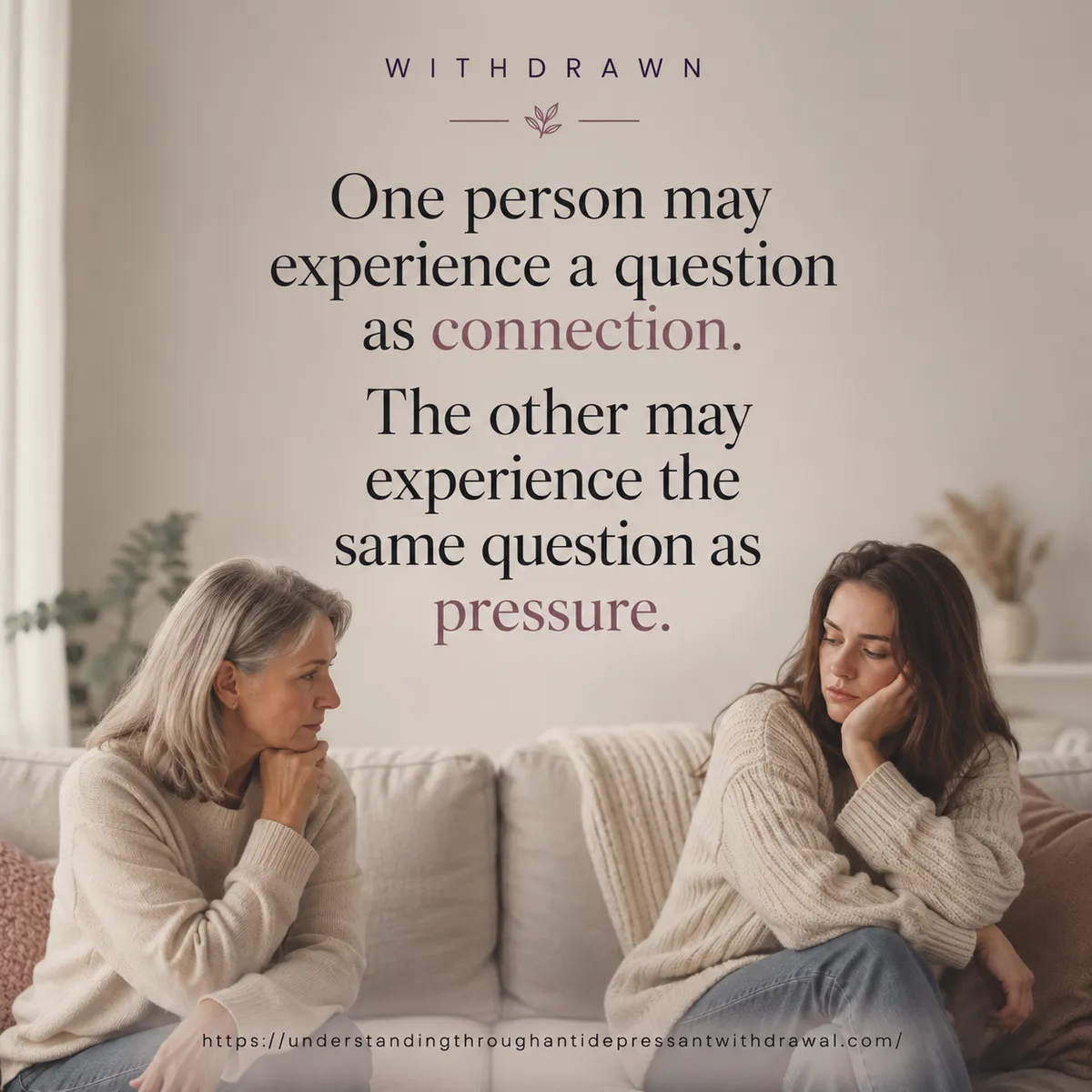
Communication During Antidepressant Withdrawal: When Talking Seems to Make Everything Worse
Communication During Antidepressant Withdrawal: When Talking Seems to Make Everything Worse
There can come a point during antidepressant withdrawal when talking, which would ordinarily be one of the ways we find our way through difficulty together, seems to make everything worse.
A perfectly ordinary question can be met with irritation, silence or withdrawal. An attempt to explain can become an argument. A conversation intended to bring reassurance can leave both people more frightened than they were before it began. Things that would once have been talked through in ten minutes can remain unresolved for days or weeks, while attempts to return to them seem only to create more pressure.
For the person experiencing withdrawal, there may be a bewildering inability to find words for something they barely understand themselves. They may know that they cannot tolerate another conversation without knowing why, or find that questions which appear entirely reasonable from the outside feel almost impossible to answer. They may need silence, space or an end to a conversation with an urgency that can be difficult to explain.
For the person alongside them, this can be equally bewildering. You may be trying to understand what is happening, trying not to get things wrong, trying to establish whether something that has been said is really meant, or simply trying to find out whether the relationship between you is all right. When the person you would ordinarily ask for those answers seems unable or unwilling to give them, the instinct can be to try harder to reach them.
This is one of the crueler paradoxes of communication during antidepressant withdrawal. The more desperately one person needs a conversation, the less able the other may be to have it.
Understanding that does not solve everything, but it can change what happens next.
When ordinary conversation stops working
Most of us have expectations about how communication works, particularly with people we know well. We ask a question and expect some kind of answer. If there has been a misunderstanding, we explain ourselves. If somebody is upset, we try to find out why. If something important has happened between us, we talk about it. If we have hurt somebody, intentionally or otherwise, we hope to understand what happened and perhaps repair it.
These are reasonable expectations, and under ordinary circumstances they are part of how relationships remain healthy.
Antidepressant withdrawal can interfere with some of the capacities those conversations require.
A person may be dealing with intense anxiety, agitation, emotional numbness, cognitive difficulties, irritability, overwhelm or a sense of disconnection from themselves and other people. Their ability to process information, hold several ideas in mind, find words, tolerate emotional intensity or understand what somebody else is asking may not be what it normally is.
This can be difficult to recognise because the person may still look entirely capable. They may be working, cooking, driving, answering messages or doing many of the ordinary things they have always done. It is easy to assume that if somebody can do those things, they should also be able to sit down and talk about what is happening between you.
But those things do not necessarily require the same kind of capacity.
An emotionally loaded conversation asks us to listen, interpret, remember, regulate our own reactions, understand another person's perspective, find language for our own experience and respond while all of that is happening. Even outside withdrawal, that can be difficult when we are frightened, exhausted or overwhelmed.
During withdrawal, it may sometimes be beyond what a person can manage.
This does not mean communication no longer matters. It means the way we communicate may need to change.
You may be having two completely different conversations
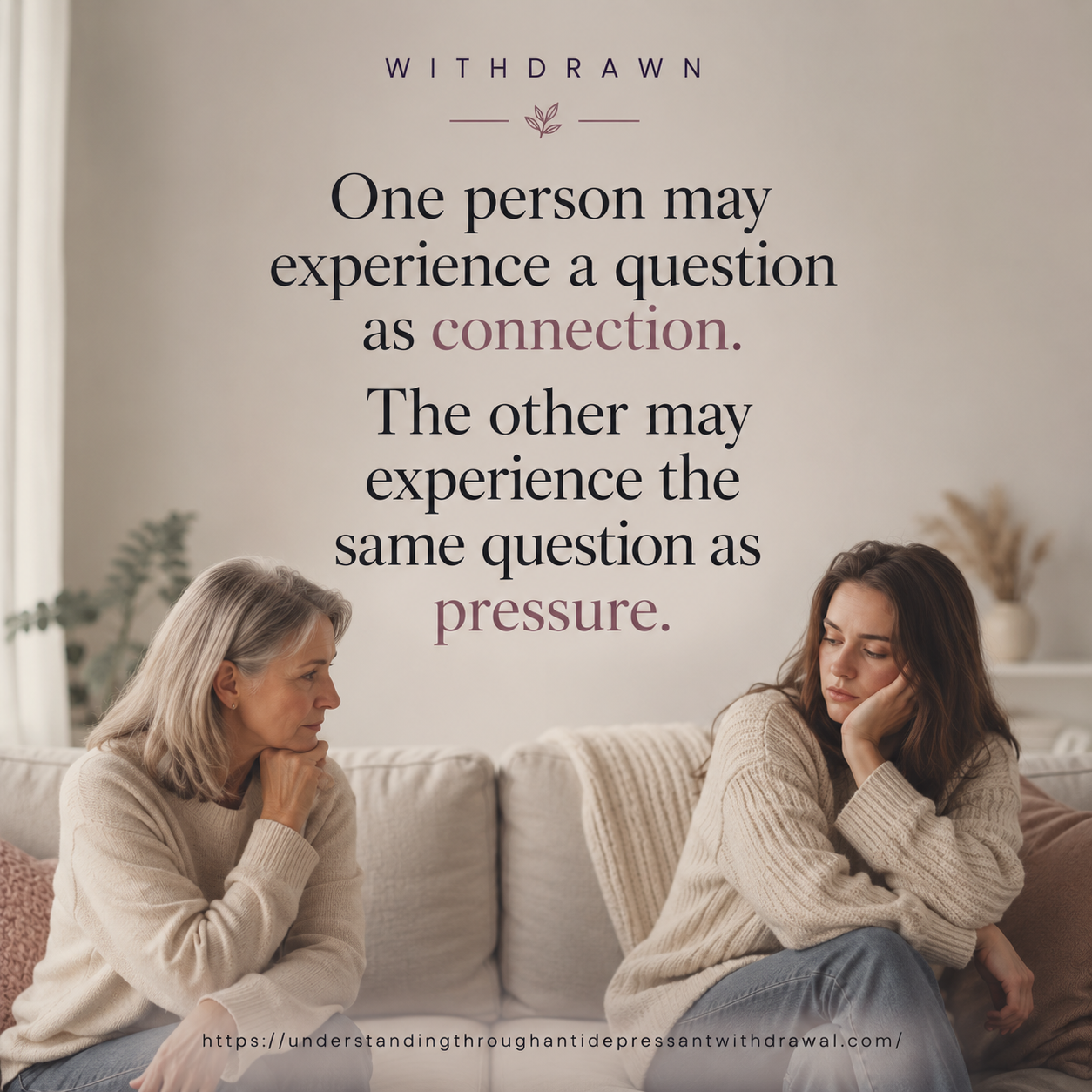
One of the most useful things to understand is that two people can be taking part in the same conversation while experiencing something entirely different.
Imagine that somebody asks their partner, “Are we all right?”
For the person asking, this may be an attempt to feel safe. Something has changed. Their partner seems distant. Affection has disappeared. They are frightened and confused, and they want to know whether the relationship is still intact.
To them, it is one question.
To the person experiencing withdrawal, it may feel nothing like one question. It may seem to contain an expectation that they should know how they feel, understand what is happening, predict what will happen next and provide reassurance they cannot currently access. They may hear pressure where none was intended.
If they say, “I don't know,” the person asking may become more frightened.
“What do you mean, you don't know?”
Now the person experiencing withdrawal feels more pressure. They may become irritated, shut down or leave the room.
From the other side, that reaction can feel alarming. A question asked because somebody wanted reassurance has resulted in the person walking away. The natural conclusion may be that something really is terribly wrong, and the need for an answer becomes even stronger.
So they follow.
“Can we please just talk about this?”
Neither person is necessarily trying to create conflict. One is trying to reduce uncertainty through connection and conversation. The other may be trying to reduce overwhelm by escaping the conversation.
The tragedy is that each person's attempt to make themselves feel safer can make the other feel less safe.
Once we understand that, some apparently inexplicable communication patterns begin to make more sense.
When fewer words are better
When something important is happening, our instinct can be to explain more. We add context, clarify what we meant, ask another question, return to something that was left unanswered or try another way of saying the same thing.
Sometimes that helps. Sometimes it creates more information than the other person can process.
During withdrawal, fewer words may communicate more effectively than a carefully constructed explanation. “You don't have to answer now” may be more useful than five minutes explaining why you need an answer. “I can see this is too much” may do more than continuing to establish exactly what has become too much.
This can feel counterintuitive, particularly if you are someone who resolves things by talking. It can also feel frightening if the subject matters deeply to you. Stopping may feel as though you are allowing something important to remain unresolved.
But stopping a conversation is not the same as abandoning the issue.
Sometimes it is simply recognising that nothing useful is going to happen by continuing it now.
The person experiencing withdrawal may also need to learn to communicate this more clearly where they can. Walking away without explanation can be deeply unsettling to somebody who does not know whether you are leaving the conversation for twenty minutes, twenty days or forever.
A few words can make an enormous difference: “I can't do this conversation now, but I'm not saying it doesn't matter.” Or, “I need to stop. Can we leave this for today?”
That may be all the communication available in that moment. It can still provide a bridge.
When questions begin to feel like demands
Questions are normally invitations to communicate, but they do not always feel that way during withdrawal.
“How are you feeling?”
“What do you want?”
“Do you still love me?”
“Why did you say that?”
“When will you know?”
“What are we going to do?”
None of these is inherently unreasonable. Some may be extremely important. But a question creates an expectation of an answer, and an answer may require access to feelings, thoughts or certainty that simply is not available.
This can create difficulties on both sides.
The person asking may feel that they are being careful, open and reasonable, while the person hearing the question experiences it as another demand they cannot meet. The more questions accumulate, the more trapped they may feel. Irritation or avoidance can follow.
That response then affects the person asking, who may begin to feel that even asking a question is somehow wrong.
It isn't.
Your need to understand has not become illegitimate simply because somebody else cannot currently explain.
The distinction that can help is between having a question and requiring an answer now.
Sometimes a question can be allowed to exist without being immediately resolved. “I do need to understand this at some point, but you don't have to answer me tonight” creates a very different experience from repeatedly returning to the question because the absence of an answer is unbearable.
For the person experiencing withdrawal, it can also help to recognise that somebody asking questions is not necessarily trying to pressure or control you. They may be trying to orient themselves in a situation that has become frightening and unfamiliar.
Both people may be looking for safety in different ways.
Listening without correcting the experience
When somebody describes an experience differently from the way we remember it, there is a powerful temptation to correct them.
“I didn't say that.”
“That isn't what happened.”
“You've misunderstood me.”
“You were the one who…”
Sometimes the correction may be factually justified. But not every moment is the right moment to establish the facts.
If somebody says, “Every time I talk to you, I feel pressured,” responding immediately with a list of occasions on which you did not pressure them is unlikely to make them feel less pressured.
Equally, if the person alongside withdrawal says, “I feel as though I can't say anything without you becoming angry,” responding with evidence that they have said plenty of things without provoking anger may miss what they are trying to communicate.
Listening does not require agreement.
It is possible to hear somebody's experience without accepting their interpretation as objective truth. “I can see that it felt that way to you” is not the same as “Your version of events is correct and mine is wrong.”
This matters particularly during withdrawal because perception, emotion and interpretation may all be under considerable strain. But it matters just as much for the person alongside. Their experience should not be erased simply because withdrawal may help explain what is happening.
Two experiences can coexist.
Explaining without demanding agreement
There may also be times when you need to explain your own experience.
Perhaps you are the person experiencing withdrawal and need somebody to understand that your need for solitude is not necessarily rejection. Perhaps you are the person alongside and need to explain that prolonged silence is frightening, even if you understand why conversation is difficult.
The aim does not always have to be agreement.
Sometimes communication becomes stuck because we are not merely trying to explain ourselves; we are trying to get the other person to see the situation as we see it. When they don't, we explain again. They defend themselves. We clarify. They correct. Soon the original issue has disappeared beneath an argument about whose interpretation is right.
There are times when the most useful thing two people can do is understand that they currently see something differently.
“I understand that you experienced that as pressure. I didn't intend it that way.”
“I understand that you need space. I also need you to know that not hearing from you is difficult for me.”
Neither statement requires one person's experience to cancel out the other's.
That may be enough for now.
What to do when a conversation is escalating
Escalation is often easier to recognise afterwards than while it is happening.
The same point is being made repeatedly. Voices change. One person begins defending themselves against things they do not believe they have done. The other becomes increasingly frustrated at not being understood. More history is brought into the conversation. Old hurts join the current one. Somebody says something harsher than they intended.
At some point the conversation stops being capable of achieving what either person wanted from it.
Learning to recognise that point matters.
The aim is not to win the conversation before stopping it. It is not to squeeze in one final explanation so the other person understands why you are right. It is simply to recognise that continuing is now likely to cause more damage than pausing.
If possible, name what is happening without assigning blame. “I don't think we're understanding each other anymore.” “I think we're both getting more upset.” “Can we stop here rather than make this worse?”
This can be particularly important when withdrawal has changed somebody's tolerance for emotional stimulation. Once overwhelm has taken over, another twenty minutes of careful reasoning may not restore communication. It may simply provide another twenty minutes of material for both people to be hurt by.
How to leave an unfinished conversation safely
Stopping is useful only if the way we stop does not create another crisis.
“I'm done with this” can sound very different from “I can't continue this conversation tonight.”
Walking out of a room may be necessary for one person and terrifying for the other.
This is where a little clarity can make an enormous difference.
If you can, distinguish between leaving the conversation and leaving the relationship.
“I need some space. I'm going for a walk and I'll be back.”
“I can't talk about this anymore tonight. We can leave it here.”
“I don't know when I'll be able to answer that, but I have heard what you're asking.”
These are not magic phrases. There will be circumstances in which even this amount of communication is unavailable. But where it is possible, it can prevent a pause from being interpreted as something much bigger.
For the person alongside withdrawal, allowing a conversation to stop may require enormous restraint. You may still be activated, frightened and desperate for an answer. Your need does not disappear simply because the conversation has ended.
That is where one of the hardest parts of living alongside withdrawal begins: learning, at times, to tolerate an open loop.
Open loops: when there is no answer yet
An open loop is something unfinished that the mind keeps returning to.
A question without an answer. A conversation that stopped halfway through. Something somebody said that you still don't understand. A decision that cannot yet be made. An uncertainty about the future that remains unresolved.
Ordinarily, we try to close these loops.
We ask again. We talk things through. We clarify what was meant. We decide what happens next.
During antidepressant withdrawal, some loops may remain open for much longer than either person would choose.
This can be extraordinarily difficult.
The person alongside may be carrying questions such as: Do you still love me? Are we still together? Did you mean what you said? Why have you become so distant? Is this withdrawal or have you changed? When will we be able to talk properly again?
The person experiencing withdrawal may have their own unanswered questions: Why do I feel like this? Why can't I feel what I used to feel? Why can I not tolerate people I love? Will this pass? Am I making things worse? What if this is simply who I am now?
The natural impulse is to find certainty.
But sometimes there isn't any yet.
Repeatedly demanding certainty from somebody who does not have it will not create it. Equally, telling the person alongside simply to stop asking, stop worrying or “give it time” does not acknowledge what it costs to live with profound uncertainty.
Open loops consume attention. The mind returns to them because unresolved things feel important. If the relationship matters to us, questions about it can become almost impossible to leave alone.
One of the skills both people may need is learning which loops genuinely require attention now and which must, however reluctantly, remain open.
That might mean explicitly acknowledging them. “We don't know the answer to this yet.” “We haven't resolved what happened.” “I know this matters to you even though I can't talk about it now.”
Sometimes naming what remains unresolved is enough to stop the other person feeling that it has simply disappeared.
An open loop does not have to be denied in order to be left open.
Staying connected without solving everything
When communication has become difficult, it is easy for every interaction to become about withdrawal, the relationship, symptoms, problems or what needs to happen next.
Eventually two people can find that they no longer know how to be together without trying to solve something.
Connection may need to become smaller for a while.
Making a cup of tea. Sitting in the same room without talking. Sending a message that requires no response. Watching something together. Walking the dog. Leaving food for somebody. Saying goodnight.
These things can look almost insignificant beside the size of what is happening, but relationships are not sustained only through important conversations.
Sometimes connection survives through ordinary moments in which nothing is being demanded, explained or resolved.
That does not mean pretending that everything is fine. Nor does it mean that serious relationship problems should indefinitely be put aside because withdrawal is happening. There may be conversations that cannot be avoided and boundaries that need to be maintained.
It means recognising that communication is larger than words.
There may be periods during antidepressant withdrawal when the conversations you most want to have are precisely the conversations you cannot have well. Trying harder does not always solve that. Sometimes what helps is less pressure, fewer words, clearer boundaries and a greater willingness to let some things remain unfinished.
For the person experiencing withdrawal, that may mean finding small ways to communicate when the larger conversation is impossible.
For the person alongside, it may mean learning that the absence of an answer is not necessarily an answer in itself.
And for both, it may mean remembering that a conversation which cannot be completed today has not necessarily been lost forever.
Sometimes the most important thing we can communicate is simply that we are still here.
